Francis Halzen Wins 2026 Nobel Prize in Physics for IceCube Neutrino Work
The Royal Swedish Academy of Sciences honoured the Belgian-American physicist for his role in the IceCube Neutrino Observatory and the discovery of high-energy neutrinos from beyond the Solar System.
The 2026 Nobel Prize in Physics has been awarded to Francis Halzen, a Belgian-American particle physicist, for his part in building the IceCube Neutrino Observatory and in the discovery of high-energy neutrinos of astrophysical origin. The Royal Swedish Academy of Sciences announced the prize in Stockholm on Tuesday, 6 October, according to reports by the Associated Press, Reuters and the Catalan outlet Ara.
The Academy’s citation, as reported by Reuters, credits Halzen with “decisive contributions” to the observatory and to the discovery of such neutrinos. The Associated Press described Halzen as 82 years old and affiliated with the University of Wisconsin–Madison in the United States. None of the reports reviewed named any co-winner, and the prize of 12 million Swedish crowns, about 1.2 million US dollars, is shared only if there are several laureates.
Neutrinos are particles with no electric charge and almost no mass that rarely interact with matter, so enormous numbers pass through the Earth and through people every second. Ara reported that, unlike many other cosmic particles, they travel without being deflected or losing energy, which means they can carry information about distant events that cannot be obtained in other ways. That same property makes them very difficult to detect.
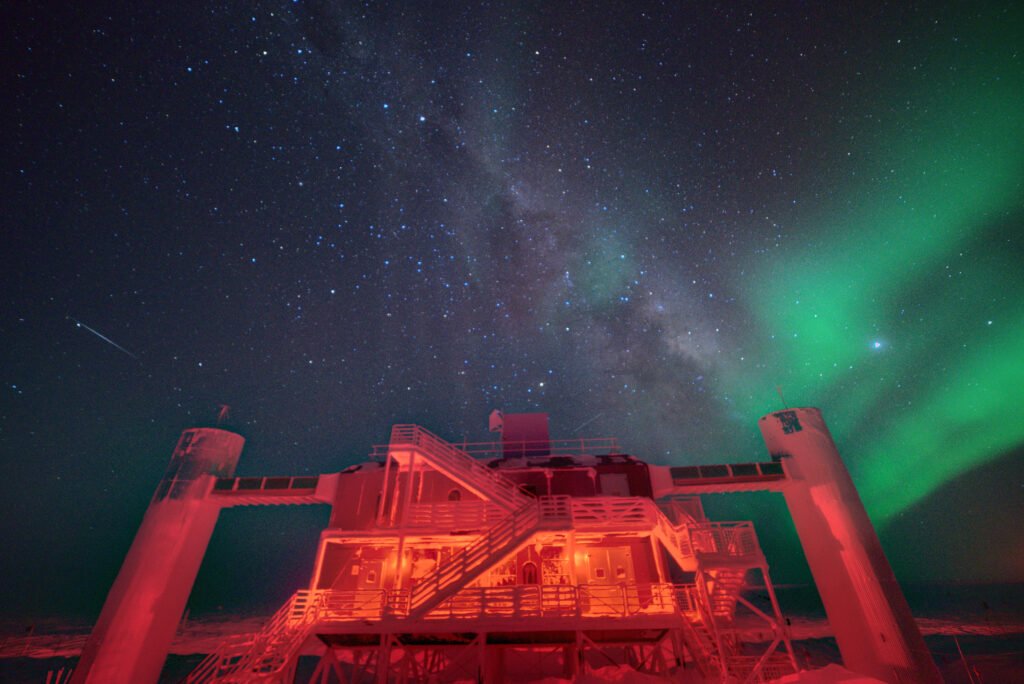
According to Ara, Halzen proposed in 1988 the idea of using Antarctic ice as a giant neutrino detector. IceCube covers a cubic kilometre of ice at the South Pole and was completed in 2011. The article says the ice there is transparent and geologically stable. When a neutrino strikes an atomic nucleus, it produces a flash of light, and sensors buried in the ice record it. A few years after completion, researchers published evidence of neutrinos that must have originated beyond the Solar System.
Ara also quoted Halzen as saying the project was “a kind of adventure in which success was not guaranteed,” and that early on “everyone thought it might be a good idea, but very few believed it would work, including myself.” It quoted Mark Pearce, chair of the Nobel Committee for Physics, as saying Halzen led an international team of researchers and engineers. The Academy said, in a statement quoted by Ara, that his scientific vision and leadership were fundamental to the observatory.
The Nobel Prize account on X said Halzen had sent a photo from a hotel room in Italy after the announcement, according to the Free Press Journal. Medals will be presented by King Carl XVI Gustaf in Stockholm on 10 December, followed by a banquet at City Hall, Reuters said as carried by Onmanorama. Last year’s physics prize went to John Clarke, Michel Devoret and John Martinis for work on quantum physics in action, according to the same report.